The Federation Table in New York City
New York City, May 20, 2026
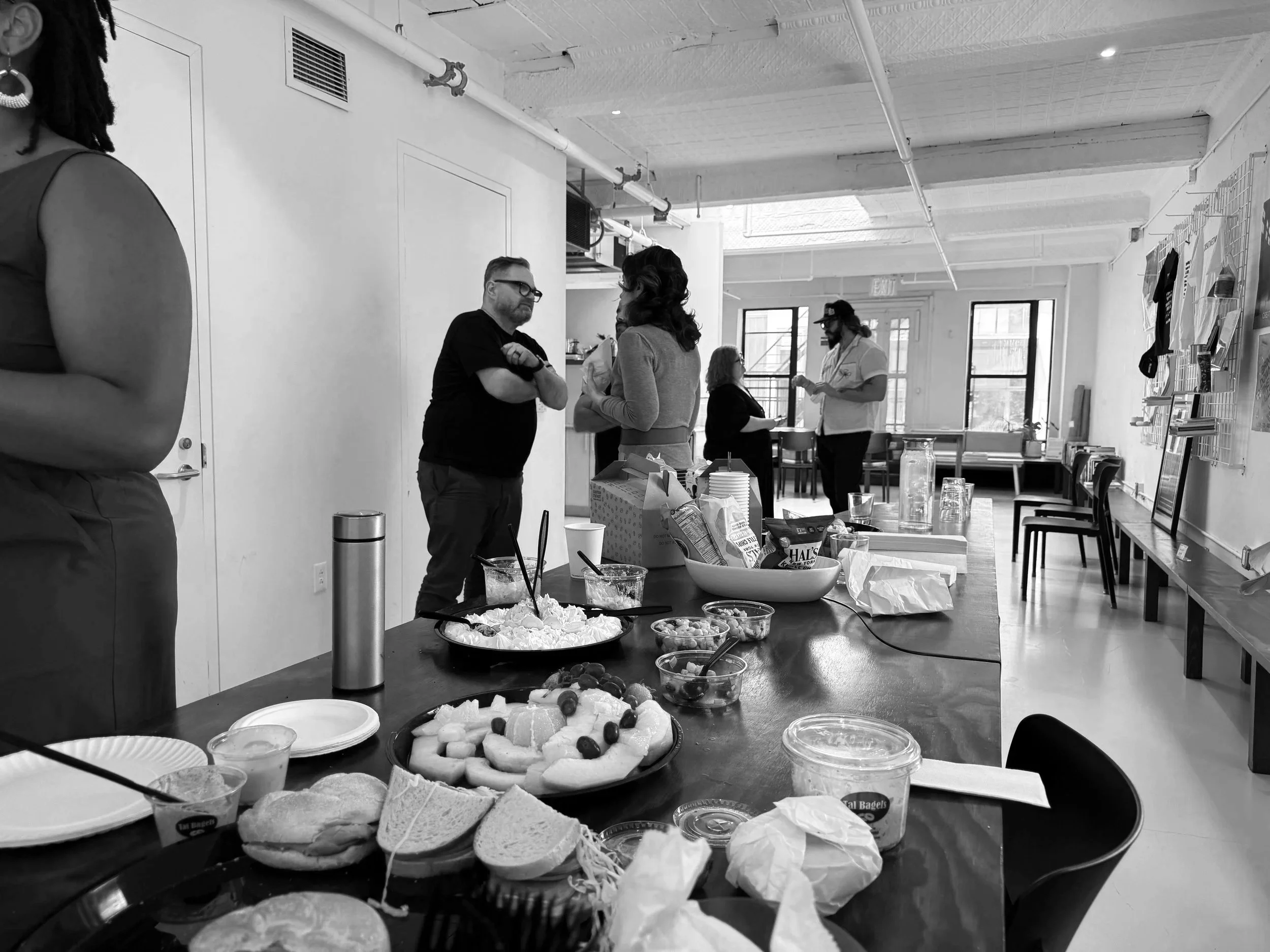
The Federation Table met on May 20th at Creative Time on East 4th Street, in partnership with IndieSpace. Convened by the Network of Ensemble Theaters, the gathering brought together ensemble leaders, solidarity economy practitioners, cooperative organizers, and cultural workers for a two-hour working brunch. The event was facilitated by Rad Pereira and Alex Meda, with Rad opening by noting the session was being recorded for an upcoming podcast.
In the room: Yuko Kudo (Prime Produce Apprentice Cooperative), Gonzalo Casals and Mauricio Melcín (Culture & Arts Policy Institute / Voices for Creative New York), Randi Berry (IndieSpace), Jenny Dubnau (Western Queens Community Land Trust), Joel Eduardo Guzmán (managing director, upcoming Hell's Kitchen building), Libertad Guerra (Clemente Soto Vélez Cultural Center / South Bronx Unite), Martikah Williams and Keesean Skinner (Black Artists Collective CNY), Megan Carpenter (Opera America), Rebecca Lurie (CUNY SLU), Alex Meda and Rad Pereira (NET).
The room held people simultaneously building community land trusts, running cooperative kitchens, designing health insurance pilots, and mapping solidarity economies, and doing all of it with a historical and structural literacy that matched the scale of the ambition.
What NET offered here resonates with what theater has always known: that the space of convening is itself a practice. The table as gathering form, not as a performance, but as intentional group dynamics, the kind of container that theater practitioners know how to build, and that organizers know how to sustain. What became visible at this Federation Table was what happens when those two traditions are in the same room: people who understand how to hold a group, how to develop trust, how to make space for the conversation that doesn't happen easily elsewhere.
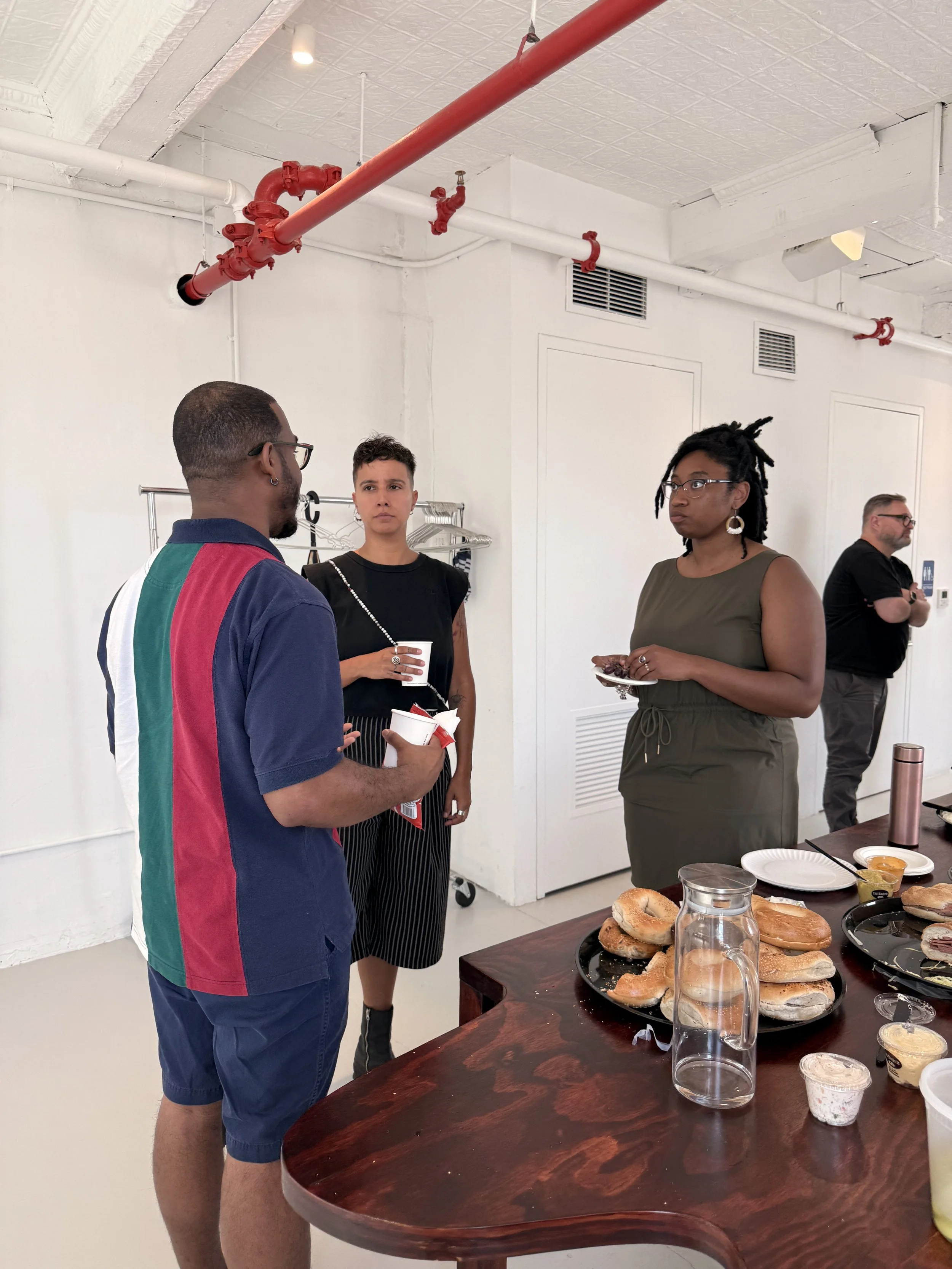
Rad Pereira chatting with Martikah Williams and Keesean Skinner at the table
The room was unmistakably New York, which is to say multinational in the deepest sense. People with roots in Argentina, Peru, Puerto Rico, Japan, Brazil, and Cuba. The cultural knowledge they brought was an analytical tool. It challenged assumptions about what organizing looks like, what infrastructure means, and what the word federation carries in different genealogies. Mauricio named it directly: federation is a word people are afraid of, a word that points at a kind of radical positioning that threatens the comfort of the current politics. In that room, people leaned into it.
What also moved me was the complementary quality of the work being described. People were operating at different scales, hyperlocal, citywide, statewide, national, and at different moments in their projects. Some were about to break ground, some were running pilots, some were mapping coalitions they barely had names for yet. The conversation felt grounded in shared interest rather than competitive positioning. The story that emerged was one of layers: different communities served, different points of entry, different tools, but an underlying structure of mutual support already partially built, waiting to be named.
A collection of phrases from the conversation:
"We need a mass interconnected arts worker movement rooted in solidarity economy."
"Come for the healthcare. Stay for the collective power building."
"Federation is a network of networks, with its own workforce and community."
"Institutional knowledge carried by elders is being lost."
"We are not changing the world alone in the arts. We change language, we can change minds, but we need to be working deeply in coalition, cross-sector."
"Ensemble practice is a civic technology we are not using the lever of enough."
"The word federation, people are afraid of that word."
I came as a witness and a listener. I left thinking about the continuity of the civil rights movement, about what it means to do R&D as an artist, about the relationship between leisure, culture, and labor, and about organizing as a way to circulate the common resources we need in the arts to survive the ever-growing precarization, between abundance and survival, the fight for dignity in artistic work. And about what it would mean to make this conversation durable, to turn the heat of the table into the structure of the federation.