We Stopped Explaining
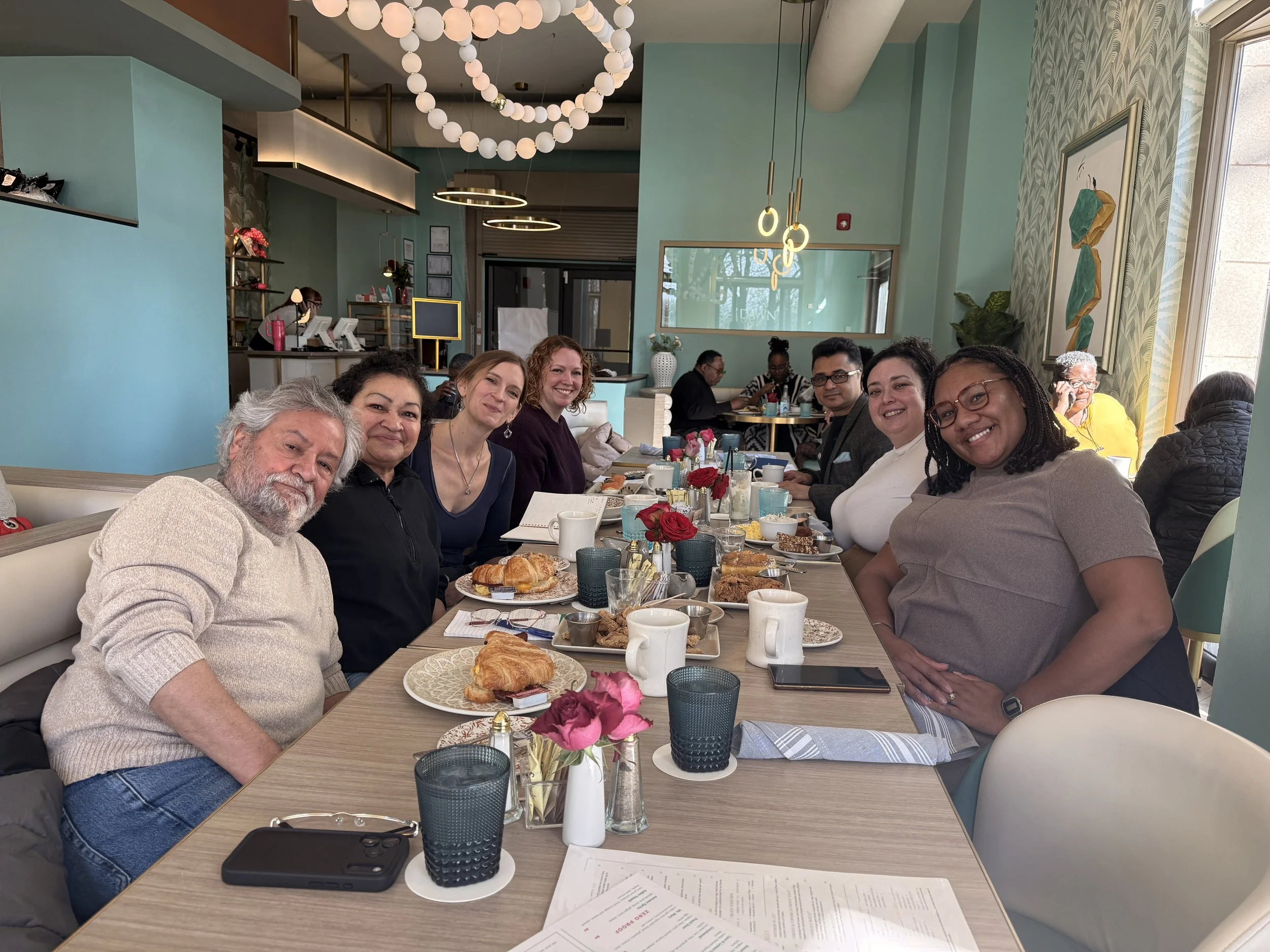
Left to Right: Martín Unzueta, Rosi Carrasco, April Doner, Supporter, Nurul Eusufzai, Alexandra Meda, Nathalie Thomas; Federation Table, Chicago NETWeek
Most of my professional life has been spent explaining.
Why ensemble theater is something the country needs. Why pooling cultural worker labor matters. Why what we hold inside theater rooms is what democracies need outside them. The explaining is exhausting. There are years I will not get back, hours that should have gone into building, that I spent translating the work into terms a person without it could metabolize. The explaining is the conservative movement's ace card. They have not had to explain to themselves why they organize across sectors. They have done it for forty years.
On March 27 at ten in the morning, I walked into a working breakfast at Dawn in Hyde Park. Dawn is a Black-owned Southern eatery on East 56th Street, opened in 2024 by Racquel Fields, who also runs 14 Parish a few blocks away. Her daughter designed the room. Teals and cream. Bird motifs throughout, because Racquel's great-grandmother went by Bird. A sculptural light fixture shaped like a string of pearls runs across the ceiling, modeled on a strand her paternal grandmother left her. Hyde Park is the corridor that has held Black intellectual and cultural life in Chicago for generations. I was gathering with people I had been talking to one at a time, asking whether we were ready to be in a room together.
I had sent 28 invitations to cooperative organizers, worker rights advocates, solidarity economy practitioners, digital commons builders, and one funder. Two organizations said yes. They forwarded the invitation to their networks. The room grew sideways.
What landed in the first fifteen minutes is that everyone there had also stopped explaining.
April Doner came from the Center for Next System Studies. She is a community builder, a twenty-year practitioner of Asset-Based Community Development, a network weaver, an artist, a mother. Her Community Power Project is mapping municipalism, solidarity economy, just transition, community organizing, and labor across cities, working toward federated groups within five years. The teach-in model her team has piloted at eleven sites in the Americas is moving toward a hundred globally by April 2027. She named the question that has shaped the inquiry: why hasn't federation worked before? Later in the conversation she said we need artists in this work to make the revolution irresistible. The line is Toni Cade Bambara's. April brought it into the room as a working assignment.
Rosi Carrasco came from Chicago Community and Workers' Rights and the Illinois Worker Cooperative Alliance. She is Deputy Director of CCWR and a co-founder and steering committee member of IWCA. Martin Unzueta, who founded CCWR and has been organizing for immigrant and workers' rights for over twenty years, was beside her. Since 2015 they have helped form nine worker cooperatives in Chicago, three of them registered. Members are formerly incarcerated people, undocumented immigrants, immigrant women carrying layered barriers. ICE raids are disrupting their work right now. One co-op member was detained in Little Village. He found a lawyer, then called to say he was going to Mexico with his family. Some members have withdrawn from co-ops because formal registration creates visibility, and visibility right now means risk.
We all contended with this in the moments after Rosi said it. The labor of being made invisible to keep your people safe. The price of formality in a country deporting your members. Rosi told us what they need: technology, training, video, worker testimony to put out so other workers see there is hope. She came with stories ready to tell. We have been making rooms for people to tell stories like that for decades. We can make more.
Nitika Nautiyal came from Builders Avenue, a 501c3 that exists to reduce the racial wealth gap by improving the financial health of BIPOC-owned construction firms. She is its chief strategy and development officer and a co-founder. Her organization incubated a shared-services cooperative for construction and professional services firms. The same shape of work ArtsPool has been building for arts organizations, ported to a different sector. Nitika is also training in Kathak, a classical Indian dance form, and dances with a Bollywood group of parents from her son's school. "My dream is if my cooperative and my dance world come together."
Nurul Eusufzai came from Chi Commons. He sits on Chicago's Digital Equity Council, where federally funded programs for digital access, devices, and connectivity are now subject to cutbacks. He named what most rooms do not name. He said the artistic community and the solidarity community talking is rare. Mostly, he said, they have been like different worlds, unless the solidarity person happens to be an artist or knows an artist personally. That is the gap the Federation Table sat on top of.
The funder in the room is a senior program officer at a foundation in a growth period. Their portfolio is expanding into sustainable artist careers, shared health plans, living wages, dignified retirement for elders. She came as someone who left theater because she could not sustain a career in it.
The line that landed early was: "We've been waiting for someone to organize this."
I felt my shoulders drop when it was said. I had not known how long I had been carrying the question of whether the appetite was real. Maybe not the appetite, but certainly questioning the capacity. We all want change, but the distractions, the distress, the chaos makes it hard to stay at the table. I remember a specific conversation earlier in 2026 with an organizer in the Bay Area where we discussed it being hard to shower every day in the current climate. But this current climate isn’t changing anytime soon, and well, we have to show up, even unshowered.
I want to name what we are organizing against and what we are organizing for, because both are real and both have lineage.
We are organizing against a withdrawal that is happening in real time. Members of the cooperatives Rosi and Martin support are being detained as we sit here. The federally funded digital equity programs Nurul names are being cut. Foundation portfolios that anchored cultural worker support are rolling off mid-cycle, mid-conversation, mid-trust. The funder in the room with us left theater because she could not sustain a career in it, and her foundation is now trying to fund into the gap she fell through. Black-led Southern arts organizations are closing this month. Lauren Turner Hines named what we are inside this week when she wrote that we are entering a second racial nadir. The cultural sector is one of the rooms where the withdrawal is most visible.
We are organizing for something that has been done before. Cultural workers and labor have built across sectors in this country for over a century. El Teatro Campesino made theater on the picket line with the United Farm Workers years before it became a theater company in its own right. Highlander Folk School trained labor organizers and civil rights organizers in the same room, and what they trained for moved a country. Hull House in Chicago ran a theater inside the same complex where its workers did factory inspections and labor organizing. We are extending that lineage.
Rad Pereira and several of us at NET have been leading our federation research for two years. The 1:1 conversations, the field-by-field mapping, the relationships with cooperative organizers and labor practitioners. There’s been thesis work, language building, and investigating what is ours to hold and what isn’t.
Who do we want to work with and who are we not aligned with?
What does alignment mean in this moment?
What is a band aid, what is a viable transformation, and what are the baby steps towards any?
What kind of resource do we need to even bring us all together?
That work, that thinking, that listening made this room possible. The breakfast was the first time we put the work in one room. And its a toe dipped. But it was also reassuring. Put gas in our tank to keep going.
This is what NET has been calling a pilot of pilots. We are convening many cooperative experiments across sectors. Health benefits. Retirement. Cooperative ownership. Mutual aid. Narrative infrastructure. Digital commons. We hold them inside one ecosystem of mutual support and learn across them in real time. The architecture that lets many interventions stand each other up is the point of the work.
NET is committing to this shape of work for the next two years. We will report out quarterly to everyone who came to a Federation Table and to our larger community. We are organizing funder briefings so what surfaces in these rooms gets advocated for collectively. We will run as many of these gatherings across the country as we can.
If you are reading this and you have been waiting for someone to organize it, we are setting the table in your city next. I will see you there.