It Starts as Art and Becomes Infrastructure

Making Together Is Organizing
Chicago figured something out a long time ago: that when you make something together, you are organizing community. It always has been that way.
When ten people walk into a room to devise a play from nothing, every decision they make is a governance decision. Who speaks first. Whose story anchors the piece. How disagreement gets held without someone leaving. How to build something that belongs to everyone and sounds like no single person in the room. Democracy practiced in the body, under pressure, every single time.
Chicago understood this before most of the field had language for it.
In 1969, two organizations launched in a city still reeling from the assassination of Dr. King and the violence of the Democratic National Convention. eta Creative Arts Foundation, founded by Abena Joan Brown and Okoro Harold Johnson, and Free Street Theater, founded by Patrick Henry as a multiracial ensemble explicitly built to break down the barriers that divided the city.
La Mont Zeno of eta said it plainly: "Most of the Black theaters established in the late 60s were formed because most Black directors and actors were excluded from participating in other theaters in Chicago."
That exclusion produced self-determination. And self-determination produced methodology. The daily discipline of making together.
In 1976, Jackie Taylor founded Black Ensemble Theater to eradicate racism through theater arts. Community as both subject and audience. Congo Square Theatre Company, founded in 1999 by a collective of Black actors determined to create space for stories rooted in the Black experience, named after the 19th-century New Orleans gathering place where enslaved Africans and free people of color gathered to sustain culture through collective practice. For 25 years, the ensemble shaped the seasons, mentored emerging artists, and built one of Chicago's most established Black theatre companies. In 2000, Teatro Luna became Chicago's first all-Latina theater because a group of women realized their stories were undervalued and decided the response was to make together. Always beginning from the same act: talking to each other about their lives.
Different reasons for gathering. Different methodologies. But sharing rich DNA: collective creation rooted in the daily lives of the people in the room. adrienne maree brown would later name this emergent strategy: non-linear, iterative, fractal, adaptive, decentralized. What works in the ensemble works in the organizing. What works in the small group works in the movement. Chicago's ensemble artists were living this framework for decades before it had a theoretical name.
127 theater companies produced full seasons in Chicago in 2019. 51 do today. That's a devastating statistic. And yet, I believe it might be more nuanced than that. Beyond the pandemic, and defunding and under-resourcing a real section of our field, the storefront and ensemble models were also built on the backs of unpaid artist labor. At its worst, this looks like a history of truly toxic and unhealthy working conditions, environments, and extractive norms finally reaching their limit. I say this as someone who was a part of that in Chicago. At its best, it creates community, innovation, and experimentation that push form and function.
adrienne maree brown writes about decomposition as a necessary phase in living systems. Things fall apart so new forms can emerge. The 76 companies that stopped producing full seasons are a grief and a signal. What's emerging from that decomposition is practitioners who are done waiting for the old model to resource them and are designing new infrastructure instead. The Federation Table exists because the artists who survived the contraction are building the systems the field never built for them.
Colonial systems broke collective practices because they threatened centralized control. The circle, collective storytelling, shared decision-making: these are indigenous practices, ancient and global. What Chicago's ensemble artists did was continue them. What this moment asks is whether the new infrastructure will match the methodology that survived.
Personally, the question isn't how to get back to 127. The question is what the 51 who remain are building, and what new forms are emerging from the soil. The practitioners are here. And the knowledge they carry, how to build across difference, how to share power, how to make something together that no single person could, is exactly the knowledge this next chapter needs.
And so, this week we gather with intention. NETWeek Chicago is four different rooms, each one practices a different scale of the same idea: that the way people practice being together determines what they can accomplish together.
Thursday: The Body
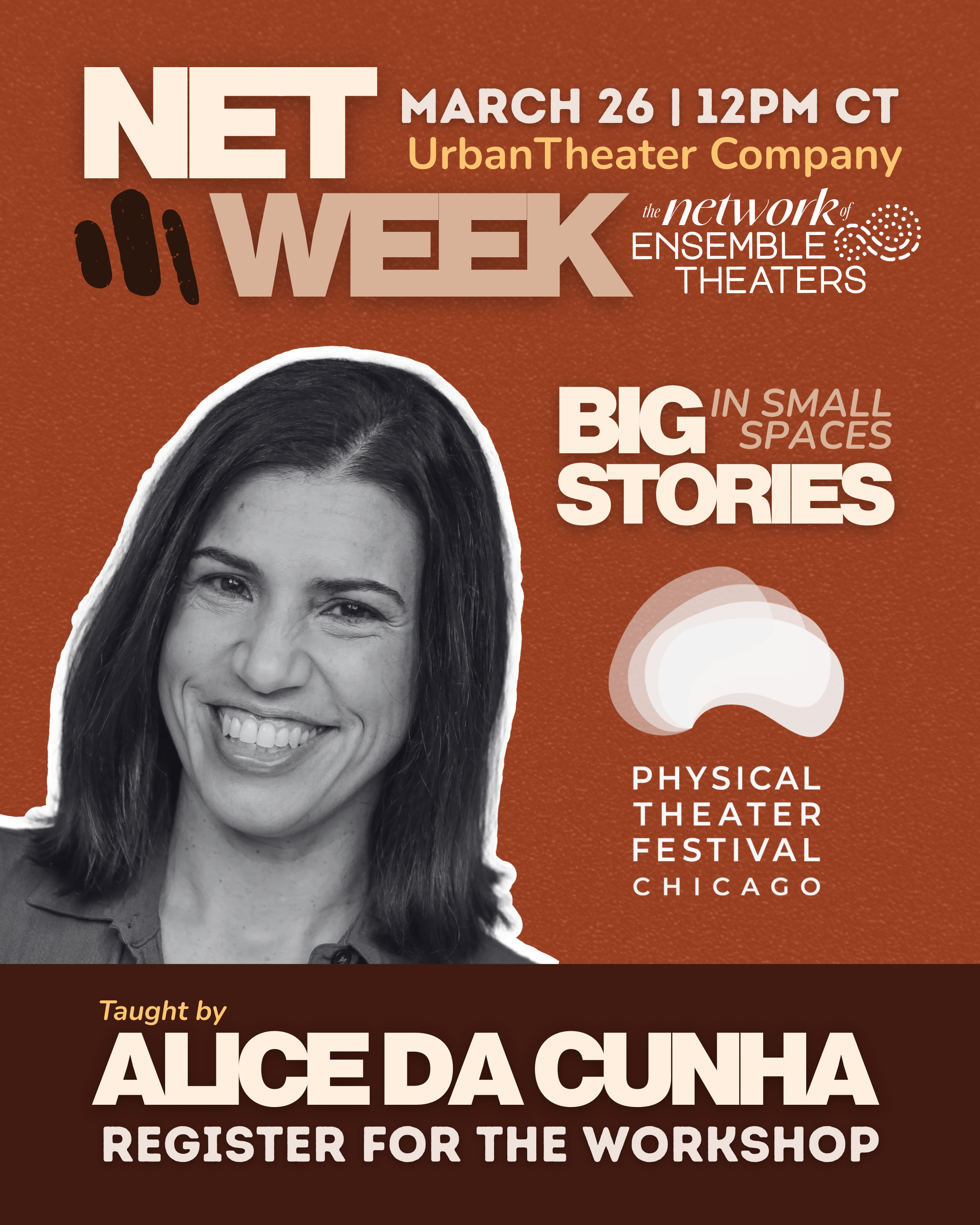
Physical Theater 101 | March 26, 12-2 PM | UrbanTheater Company
Before the conversations, before the infrastructure, before the public record: the body in the room.
Alice da Cunha of Physical Theater Festival brings Lecoq technique to UrbanTheater Company in Humboldt Park. Playful, precise, physical, open to all levels. Ensemble practice lives here before it becomes language, before it becomes governance, before it becomes a funding proposal. In the body. In the circle. In the ancient practice of people moving together and discovering what they know collectively that they could not know alone.
In a political moment designed to make people feel helpless and isolated, this is what ensemble methodology offers: something to do with your body and your collective presence.
Friday Morning: The Infrastructure
The Federation Table | March 27, 10 AM-12 PM | Dawn Chicago
$15,000. That is the median lifetime retirement savings for artists in this country. No health insurance. No pension. No safety net underneath the people building the stages, the programs, the rooms this city celebrates.
We keep calling it passion. We keep calling it the cost of doing what we love. It's a policy failure.
The people who practice collective decision-making as a daily discipline, who already know how to build across difference, who already govern by consensus and shared power, are the people who should be designing the material infrastructure for their own survival. They should be designing it themselves, because the institutions that have never been inside the practice keep getting it wrong.
The Federation Table is a working breakfast series launching in Chicago as the first public room of NET's Federation Pilot Initiative. Cultural workers, labor organizers, and cooperative builders at the same table, designing what should already exist: portable benefits, shared purchasing, mutual aid. This is what emerges from the decomposition. The old model didn't sustain these practitioners. The new infrastructure has to be built by the people who survived it. This is cooperative and solidarity economics applied to the cultural sector. The skills transfer. The values are already there. Making together is organizing, and organizing is how you build the systems that let you keep making.
NET is actively seeking new members of a growing coalition. If you've been building cooperative infrastructure, solidarity economy networks, mutual aid, or labor organizing in any sector and want to connect that work to the cultural sector, this table is for you. Breakfast is on NET. Bring what you know. Be ready to ask for what you need.
Friday Afternoon: The Practice
Ground Floor | March 27, 2-4 PM | Definition Theatre
There is a kind of knowledge that lives inside storefront theater companies that never gets published. How to hold an ensemble together through a decade of precarity. How to train the next generation while producing original work. How to share power when the stakes are real and the resources are thin. This knowledge gets passed between practitioners in hallways and parking lots, not in keynotes.
Chicago has more of this concentrated in one city than almost anywhere in the country. And most of the practitioners carrying it have never been in the same room together to share it.
Ground Floor is the simplest thing in the world. Practitioners in a room, sharing what they know. Miguel Angel Rodriguez from Albany Park Theater Project, where ensemble-devised theater has been made with and by young people and immigrant communities since 1997. Megan Carney from About Face Theatre, three decades of queer ensemble practice. SK Kerastes, who stewarded the intentional sunsetting of Links Hall after 46 years and has been sitting with what it means to close a space with the same care you opened it.
Each opens with what they carry. Then the room builds. We don't do this enough.
Saturday: The Record
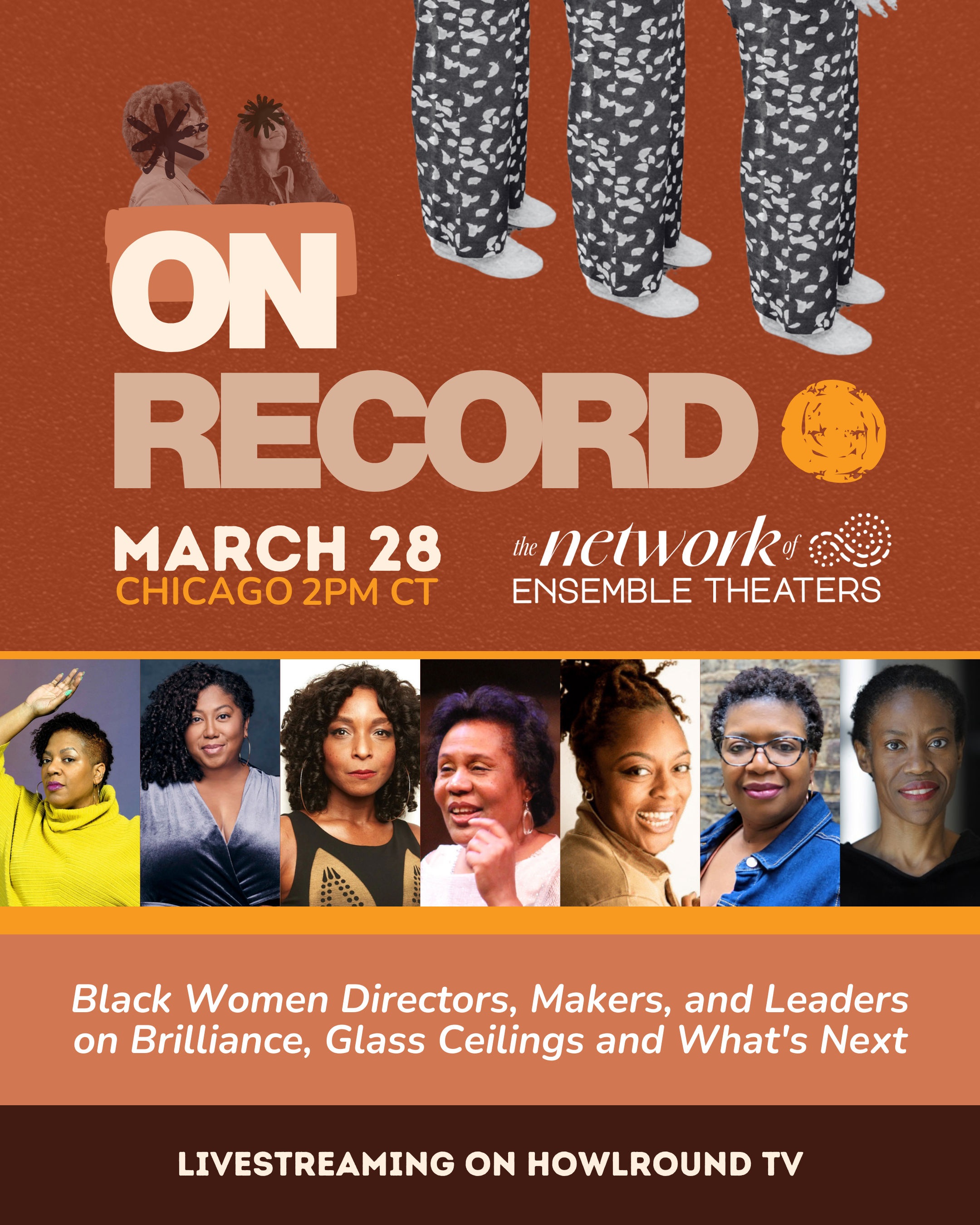
On Record | Chicago | March 28, 2 PM | The Guild Row (also livestreamed on HowlRound TV)
Black women in Chicago direct, devise, produce, and lead at extraordinary levels. And the ecosystem doesn't match it. Directors without health insurance. Leaders building institutions with no safety net underneath them. Brilliance that the city celebrates and then fails to sustain.
On Record puts that gap on the table.
Jackie Taylor, who founded Black Ensemble Theater in 1976 and has produced over 100 original works. Ericka Ratcliff, former AD of Congo Square Theatre, now at Chicago Shakespeare, who has worked as literary manager, casting director, and director. Lili-Anne Brown, five-time Jeff Award winner who has consistently centered Black creatives and Black stories across Chicago's institutional stages. J. Nicole Brooks, actor, playwright, and Creative Producer at Lookingglass, whose original plays excavate Chicago's unfinished reckonings. Miranda Gonzalez, Producing Artistic Director of UrbanTheater Company, founding ensemble member of Teatro Luna, two decades of devising original work that centers Latina and Black communities. Roxanna Conner, whose work previously at Victory Gardens and now at NIU's School of Theatre and Dance shapes the next generation of practitioners.
Six Black women directors, makers, and leaders speaking on the permanent public record about what it actually takes to build legacy inside a city and an industry that was not designed to hold what they are building. Carmen Morgan of artEquity facilitating. Permanently archived. Live captioning and ASL interpretation. Reception to follow.
The Fractal
Thursday you move together. Friday you design infrastructure and share practice. Saturday you witness six women put their legacy on the permanent record.
Each room feeds the next. The trust built in the body carries into the working breakfast. The practice shared Friday afternoon is the same practice that built the careers being honored Saturday. That is the fractal adrienne maree brown writes about: what works at one scale works at every scale. What works in the ensemble works in the organizing works in the movement.
What does it take to go from organized to powerful? We think it starts with being in the room.
Registration and full details: ensembletheaters.net/netweek-chicago. $25 for the full week. Waiver codes available. Comp code Chicago100 for complimentary access.
Isolation is a weapon. Relationship is the resource.